
We write a script for every customer interview. The person on camera never sees it.
Published on
September 22, 2026
Estimated reading time:
9
minutes
Every customer testimonial video starts the same way. Somewhere on your marketing team there's a brief, and the brief lists the messaging pillars the video has to hit: the problem your product solves, the reason the customer chose you, the result they saw, maybe a line about the partnership. One of your customers has agreed to give you an hour on camera. Now somebody has to turn that brief into a video.
The way most production companies handle that is to write interview questions. They look at each pillar, write two or three questions that should get the customer talking about that pillar, put them in a sensible order, and show up on the shoot day with a list. It's not a bad process, and it's how most customer videos get made. It's just an incomplete one, and you usually find out where it falls short after you've already paid for the shoot. We typically do it a bit differently. Before we write the interview questions for a customer testimonial video, we write the script.
Here's the problem with going straight from brief to questions. Questions get you answers, but they don't get you a video. You can walk out of an interview with an hour of thoughtful, articulate footage in which every pillar is covered, then sit down to watch the first cut and discover there's no story in it. Nothing connects. The setup runs long. Three of the six product points sound like a datasheet being read aloud. Everything the brief asked for is in there, but the video doesn't deliver the impact you were looking for, and at that point the only fix is a re-shoot nobody budgeted for.
We hit that wall enough times that we added a step to our customer testimonial video process. After we've reviewed your brief and before we write a single interview question, we write the script. And unlike a lot of what happens in pre-production, this is something you'll see.
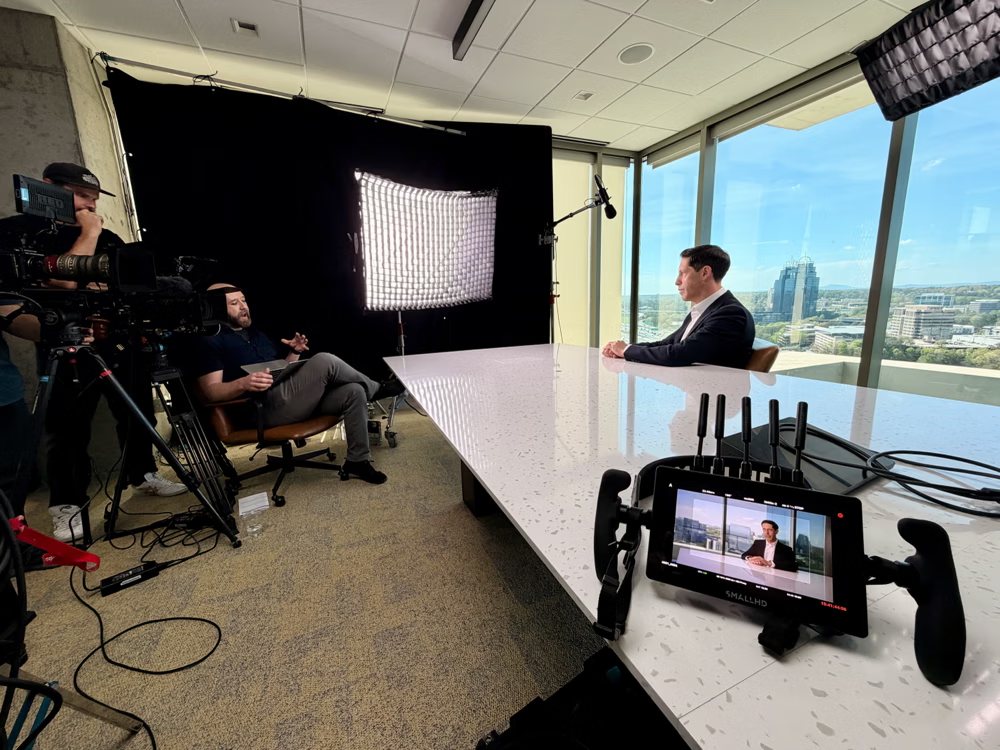
We write the customer testimonial video script first
The step itself is simple. We take your brief and ask one question about it: if this customer could say exactly the right thing, in exactly the right order, what would that sound like? Then we write it down as if the video were going to be fully scripted and read off a prompter. We give it a hook, a beginning, a middle, and an end. We write the setup, the decision your customer made, the proof that it was the right decision, and the payoff.
None of it will ever be filmed the way it's written. The interview will still be a conversation, and your customer will still answer in their own words, because that's what makes a customer story authentic, and authenticity is what makes it worth watching in the first place. The script isn't a literal script, in the traditional sense. It's a planning tool, and it exists because a script has to work as a video, while a list of questions only has to cover a brief. Writing a sample script is the fastest way to discover any issues that would otherwise stay hidden until the edit, or to confirm that we have all our bases covered.
From the sample script to the testimonial interview questions
Once the script holds together, we take it apart. Each beat becomes a question written to lead your customer toward that idea without putting words in their mouth. Those questions become the interview guide, and we walk into the room knowing the exact story we're after and the handful of lines we need to hear in your customer's own voice. The questions are still what drive the interview. They're just better questions, because they were built backwards from a video that already worked on paper.
What the sample script tells us before you've spent a dollar filming
The script itself isn't the point. The point is what we learn while writing it, and we learn it at the cheapest possible moment: before anyone has booked a crew, blocked your customer's calendar, or gotten on a plane. These are the things we find most often, and the things we'll flag for you when we do.
There's too much product in it. A brief written by a product marketing team naturally wants every pillar in the video, and on paper six product points looks like a thorough brief. Written out as a script, the same six points read like a spec sheet with a face attached. The script shows which two or three the story can actually carry, and it gives us something concrete to bring back to you so your team can prioritize the ones the video will cover. That conversation is much easier to have over a two-page document than over the first cut of a video.
The setup takes too long. Some customer stories are complicated. Who the customer is, what they were doing before, why the problem mattered, who else was involved. In a brief, that context is a paragraph. In a script, it's ninety seconds of video before anything happens, and nobody watching a customer story waits ninety seconds for it to start. Finding that out on paper means we can condense the setup while condensing is free, instead of trying to cut around it in the edit.
Two parts of the story don't connect. The brief wants the story to go from the old way of working to the result. Writing the script, we sometimes find there's nothing in between, and no natural way for your customer to get from one to the other in conversation. That gap is a transition line we need to capture on the shoot day, and it's something we can't ask for if we never knew we needed it. A question list won't reveal a missing transition. A script highlights it.
We can see the b-roll. B-roll is the footage of your customer at work that plays over the interview. Every line in a script raises the question of what should be on screen while it's being said, and the answers become the shot list. That's how we know, before the shoot, whether your customer's office has what the story needs or whether we're going to be leaning on graphics or stock footage. A list of interview questions, by contrast, tells us nothing about what to film beyond the person answering them.
We can see how many people belong in it. When three people from your customer's side want to appear on camera, or when your account manager wants the executive, the buyer, and the user all featured in the video, the script shows whether the story has three roles in it or one. Sometimes it has three, and the script tells us how to divide it. Sometimes it has one, and the script gives you a way to have that conversation with your customer before the shoot, rather than after two of their people have given up an afternoon and don't make the final cut.
It puts us on the same page as you, early
There's a second benefit that has nothing to do with the edit and everything to do with how the project feels to you. We share the script with you before anyone is on camera. That lets you understand what's going to be in the video and, just as important, how much of it. A three-minute customer story can't hold everything a brief asks for, and the script is where that gap becomes visible. It's far better to close it in a document you can mark up than in a review of the first cut.
It also means your legal, PR, or brand teams can weigh in on the message before the shoot instead of after the edit. That's the step that keeps launch timelines from breaking. When they've approved the story in writing up front, their review at the end is about the edit, not the message.
The one expectation we'll set with you
Your customer won't say it the way we wrote it, and they're not supposed to. That's the whole reason the interview stays conversational, and it's the one thing we ask you to keep in mind when we send the script over. It's the story we're aiming for, not the exact words you should expect to hear. If you read the final video against the script line by line, they won't match, and that's the process working. What you should find is the same story, told better than we could have written it, because it came from the person who lived it.
The one rule
Your customer never sees the script. Not the script, not the soundbites, not a summary of the points we're hoping they'll make. The moment someone reads what they're supposed to say, you no longer have a customer telling you what happened. You have a spokesperson reciting lines, and everything that made their story credible is gone.
What your customer gets is a conversation on the day, a set of questions that make it easy for them to tell their story well, and the experience of being surprised at how good they sound.
Where this has proved out
The Aprio story we produced for Intuit is a good recent example of how much work the script does. It hit every item on the list above. We changed the entire framing of the story twice before the shoot. It did the thing we said it would: it forced the question of what the video was actually about, and it got every stakeholder to agree on the answer, because they could read a story instead of a list of questions. The interviews on the day were as conversational as any we've filmed. Without the script, it would have been a very different video, and not a better one. The Aprio project is worth its own post, and it will get one.
If you're planning a customer video
Whether you work with us or someone else, ask your production partner one question before the shoot: can you show me the story before we film it? If the answer is a list of interview questions, you're going to find out how the video works at the same time they do, in the edit.
The script adds time to pre-production, usually about a week. It also keeps earning its place after the shoot is planned. We have it on set as a reference during the interview, and our editor works from it in post, which keeps the edit on track with the story you and we agreed to instead of drifting toward whatever the most quotable moment happened to be. Some clients ask why they're paying for it. In our experience, it's the cheapest week of the project, because it's the week that keeps every later week from getting longer.
Planning a customer story? Here's how we approach customer testimonial video production.

Author:
Eric Stracke
Eric is the Co-Founder and Creative Director at Gorilla Creative. He earned a B.S. in Digital Film and Video Production from the Art Institute of California, San Francisco. He finds great satisfaction in the creative process of producing a video from concept to completion.


Gorilla Creative is a full service corporate video production company located in San Francisco, California.
hello@gorillacreative.com | (415) 907-4427 | 535 Mission St, Floor 14, Suite 1681, San Francisco, CA 94105
© 2026 Gorilla Creative. All rights reserved. Privacy Policy